
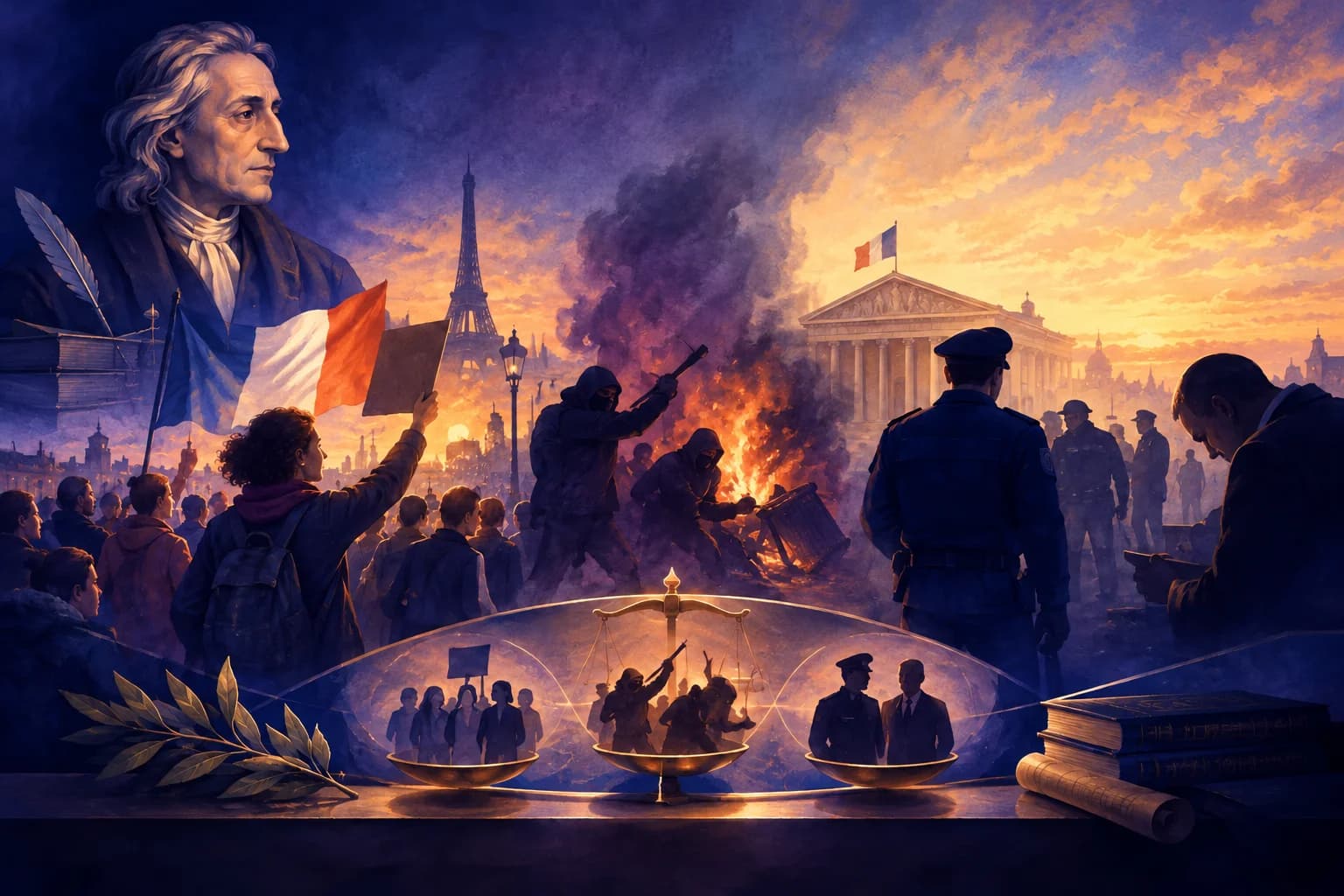
What Locke would say to a government trying to put out fires, literal and otherwise.
Every government eventually learns that it has two jobs, and that they refuse to take turns. The first is keeping people safe. The second is listening to why they’re angry. France is now trying to do both at once, in public, with the cameras rolling.
What began as student protests over schools has grown into something much larger, and in places much uglier, leaving deaths, injuries and charred buildings behind. Emmanuel Macron has answered with two promises: prosecute those responsible for the violence, and sit down with students, teachers, trade unionists and others to talk. The interesting question isn’t whether either promise is good. It’s whether he can keep both at the same time.
It started with classrooms
The movement’s original wish list wasn’t exactly the stuff of revolutionary manifestos. It asked for smaller classes, more teachers, school buildings that can handle a changing climate, and an end to police violence against young people. From there it widened into frustration over the rising cost of living and a sense that the people in charge weren’t doing much about it.
That origin story matters. Stopping fires is an emergency measured in hours. Fixing schools and convincing people that someone is actually listening is work measured in years. Treat the whole thing as a policing problem, and you’ve answered a question nobody asked. Treat it only as understandable frustration, and you’ve shrugged at people who were genuinely hurt.
Even officials acknowledge that the vast majority of demonstrators were peaceful. Yet the reported toll is grim: two deaths, more than 2,000 people detained, more than 600 police officers, gendarmes and firefighters injured, serious injuries among protesters, and damage to public buildings and businesses.
It’s tempting to squeeze all of that into a tidy headline: “Violent Mob” or “Brutal State.” Pick your team. Resist the urge. A detention is not a conviction. An injury doesn’t tell you who caused it or whether the force behind it was justified. Three different things are happening here: peaceful protest, private violence and alleged abuse of public power. Each one demands its own response.
Locke’s job description for governments
John Locke had firm opinions about what government is for. In section 131 of the Second Treatise of Government, he argues that political power exists for the common good. It should work through settled laws and impartial judges, aimed at the people’s peace and safety. Notice what’s missing from that list: “regaining control” is not a justification on its own. Calm is the means, not the mission.
Apply that to France, and the picture sharpens. Protecting residents, shopkeepers, demonstrators and police officers is one job, not four competing ones. A peaceful marcher doesn’t become a suspect because someone three blocks away set a car on fire. And a righteous cause doesn’t come with a free pass for assault.
Before anyone recruits Locke as the patron saint of the barricades, note that he wasn’t handing out permission slips. In section 207, he separates situations where the law still offers a remedy from those where unlawful force has blocked the road to one. Being furious, even justifiably furious, isn’t the same as having no other option.
So the students’ demands deserve a serious hearing, and attacks on people and property deserve consequences. Prosecuting rioters won’t tell you whether the schools are adequately funded. Funding the schools won’t answer for a torched storefront. A good response keeps both ledgers open.
Who polices the police?
Then come the incidents that make “law and order” sound a lot more complicated: a 14-year-old with a fractured jaw, an officer reportedly filmed holding a girl in a headlock, a teenager who lost a hand when a police grenade exploded. Video clips and early reports can’t settle what happened in each case. But they raise questions that promises to punish rioters simply don’t touch. Was the force necessary? Was it proportionate? Did orders, equipment or supervision play a role? Can the injured get a real remedy?
Locke saw this coming, too. In section 202, he argues that an official who goes beyond lawful power and uses force against someone’s rights has, in that moment, no authority at all. A badge is a grant of trust, not a blank check.
That means investigations should look at individual officers and at the command decisions above them. This isn’t a claim that police and rioters are morally equivalent. Their circumstances and intentions may differ enormously. But public officials wield borrowed power, and borrowed power comes with an obligation to show the receipts. An injured officer deserves concern without that concern shielding the institution from scrutiny. An injured protester deserves concern without anyone prejudging every allegation against the police.
Talk is cheap. Trust is expensive.
Macron plans to meet with mayors, and his government says it will convene students, teachers, unions and others. Earlier talks between the education minister and student protesters ended without a deal.
No deal isn’t proof that dialogue is pointless. People disagree in good faith all the time. But a meeting is a process, not a result, and plenty of governments have perfected the art of the consultation that consults nobody. What counts is which proposals actually get considered, what reasons come with the decisions, and whether anyone follows through.
Here Confucius offers a useful counterweight to Locke. In Analects 2.3, he contrasts ruling by punishment, which gets people to obey without feeling any shame, with leading by virtue and ritual propriety, which actually shapes how people treat one another. In Analects 12.7, asked what a state needs, he names enough food, enough weapons and the trust of the people. If something has to go, drop the weapons first, then the food. Trust is the one thing a government cannot do without.
For France, that’s a challenge to make consultation believable through behavior: acknowledging the injured, explaining policy choices, and reporting back on what the promised discussions actually produce. (To be clear, that’s my application. Confucius did not leave notes on the Fifth Republic.)
The two traditions don’t fully agree, and that’s worth saying out loud. Confucian thought prizes exemplary leadership within hierarchical relationships. It isn’t a theory of equal democratic participation. So I’ll keep Locke’s objection in my back pocket: good character is lovely, but it’s no substitute for enforceable safeguards. We need protection for the days when leaders behave badly, not just faith that they won’t.
What “order” actually has to mean
France is facing an emergency nested inside a political argument, and its government’s response should be judged on both levels.
The short game: protect people, care for the injured, investigate, and try cases on individual evidence. The long game: schools, household budgets, and the feeling among many citizens that the system wasn’t built with them in mind. Neither should become the excuse for endlessly postponing the other.
My standard isn’t order at any price, and it isn’t resistance without limits. It’s accountability that can tell different kinds of conduct apart, paired with political participation that can actually change outcomes.
Quieting the streets would be an achievement. Earning a public order that people trust is a much bigger one. That takes restraint in using state power, consequences for proven wrongdoing, and a real answer for the people who walked out peacefully in the first place. Locke would call it legitimate government. Confucius would call it trust. Either way, riot gear alone won’t deliver it.
Further reading
John Locke, Second Treatise of Government (§§131, 202, 207)
Confucius, Analects (2.3, 12.7)
Stanford Encyclopedia of Philosophy, “Confucius”
CNN, “France’s Macron vows to hold accountable those who ‘sought to bring down the Republic’ during major protests” (Oct. 17, 2026)